
Marshall County Warrant Checks
The best public tool is Iowa Courts Online. Choose Trial Court, then Case Search. Set the location to Marshall County and enter a case or citation number if you have one. A name search can still pull up the public docket. It just cannot certify that no warrant exists. Docket entries, warrant applications, new citations, and law-enforcement status do not all surface at the same speed. Before calling, write down the full legal name, date of birth, county, case or citation number, issuing agency, and the approximate incident or court date. The clerk will ask for most of that. And if the matter touches you, talk with an Iowa attorney before arranging an appearance or surrender.
- Search the public Iowa District Court docket and select Marshall County.
- Check an eligible citation or court debt by name, case ID, or citation number.
- Call the Clerk of Court to confirm the docket event and issuing authority.
- Call Sheriff Records or the issuing police agency to confirm service status.
- After the court acts, confirm the return or recall with both custodians.
Iowa Courts Online Starts the Search
Iowa Courts Online is a court-case channel rather than a sheriff warrant index. Its payment search offers two modes. Pick By Name or By Case or Citation Number. Name mode requires a case type, a county, and at least two characters each for the first and last name. A partial citation search accepts the last four to six digits. Identifier mode wants the entire case ID or citation number. The official payment interface lays out those neutral controls, and any Marshall County case you find there reflects the same district-court docket.
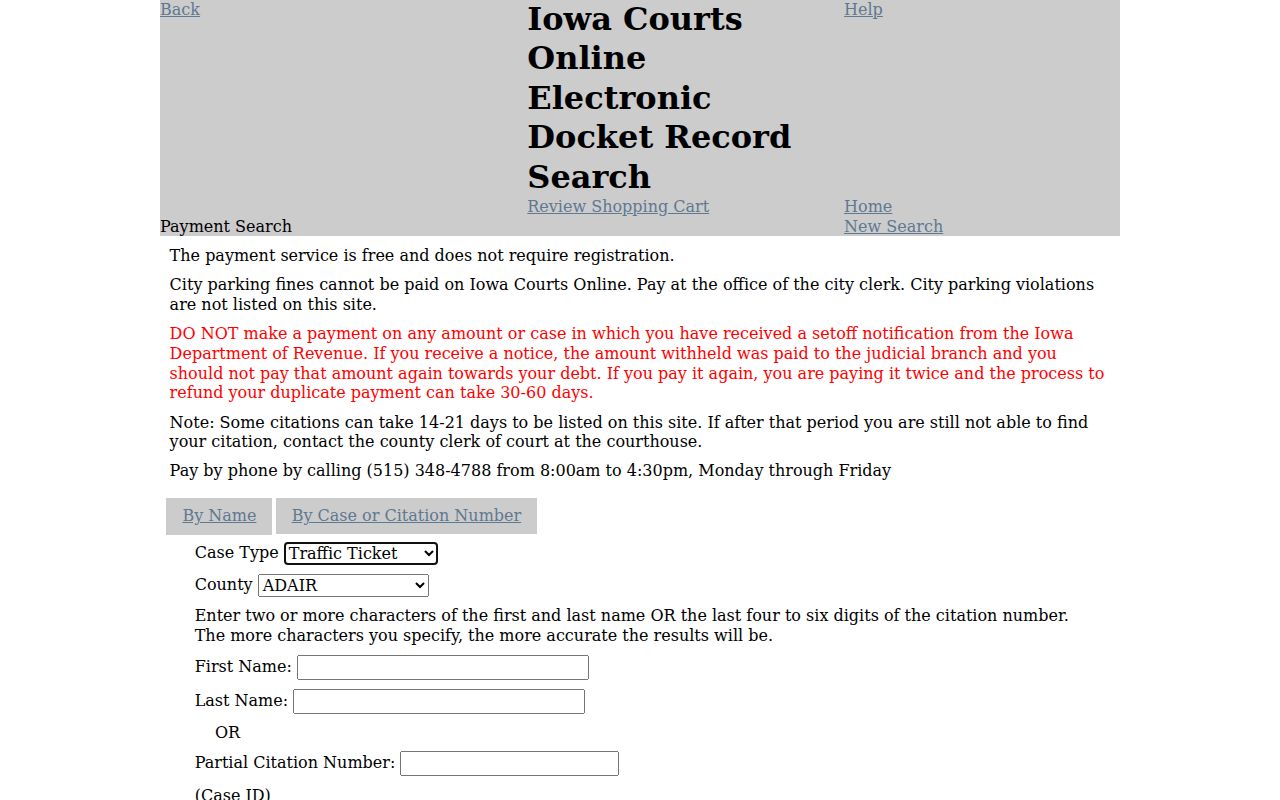
Payment eligibility and warrant status are different questions. The docket holds the answer. Look for any required appearance, bond, motion, or order on a Marshall County case, and ask the clerk when unsure.
| Control | Use | Limit |
|---|---|---|
| County | Select Marshall | A Le Grand case may belong to Tama |
| Case Type | Narrow the results | Use the docket classification |
| Name | At least two characters each | Common names need confirmation |
| Partial Citation | Last four to six digits | Recent citations may lag |
| Case ID | Complete identifier | County is also required |
Warrants in Marshall County: The Main Types
Iowa terminology matters here. An arrest warrant grows out of a complaint or affidavit showing probable cause. Miss a required citation appearance on purpose, and a failure-to-appear arrest warrant can follow. People say "bench warrant" loosely for whatever a judge issues after a missed setting or another violation. The exact docket language controls, though. Marshall County dockets use plain warrant terms rather than capias or capias pro fine.
| Type | How it arises | Authority |
|---|---|---|
| Arrest warrant | Probable cause in complaint or affidavit | District judicial officer |
| FTA arrest warrant | Willfully missed citation appearance | Iowa District Court under §805.5 |
| Bench warrant | Informal label after missed court duty | Docket wording controls |
| Search warrant | Authorizes a search on probable cause | Separate judicial process |
Iowa's Unified Court Changes the Route
Iowa consolidated its courts a generation ago. The 1973 Unified Trial Court Act wiped out municipal, mayor's, police, county, and justice-of-the-peace courts across the state. Every Marshall County matter now sits in Iowa District Court, Second Judicial District, subdistrict 2B. Three kinds of judicial officers share the work. District judges hold general trial authority, including felonies. District associate judges keep magistrate power plus broader misdemeanor, class D felony, civil, and juvenile jurisdiction. Magistrates handle scheduled violations, simple misdemeanors, initial appearances, preliminary hearings, municipal infractions, and search-warrant proceedings. That history explains a common dead end. A Marshalltown or State Center citation does not feed a separate city-court warrant database, because that court no longer exists. The police agency may originate or enforce the case. The Marshall County Clerk keeps the district-court docket. Work with both, not with a municipal courthouse. And when you ask the clerk to locate an order, keep the division and the judicial-officer name exactly as the docket shows them.
Marshall County Warrant Records: What They Show
What you get is usually a string of docket entries, not a single warrant card. Look for the case or citation identifier, the complaint or affidavit, the defendant name, the offense and code section, the issuing officer, the reason for the order, endorsed bail or release conditions, and the service or return. No local warrant-number format or active/cleared code list is published. So do not decode an unfamiliar number by guesswork. Ask the Marshall County clerk instead.
| Case or citation number | Official identifier, such as CASE ID FROM DOCKET; no local warrant pattern was verified. |
|---|---|
| Charge | Offense, Iowa Code section, and classification. |
| Issuing authority | District judge, associate judge, or magistrate. |
| Bail | Amount or conditions, subject to current case confirmation. |
| Service/return | Execution, appearance, and paperwork returned to court. |
| Status | Public docket events, not necessarily live agency status. |
A Blank Result Does Not Prove Clearance
Common mistake: A blank Most Wanted page, payment result, docket search, or inmate roster does not establish that no warrant exists.
A blank search result proves nothing. The Judicial Branch says a citation can take 10 to 14 days to post. The payment interface warns of 14 to 21 days. Supporting papers for an unserved warrant may stay confidential. And a Marshall County warrant check can still miss something that sits in another county, shows only as a docket event, or falls outside the sheriff's curated selection. So keep working the chain. Call the clerk for the court record, then Sheriff Records or the issuing agency. After a payment, appearance, bond, recall, or return, get confirmation of the docket update rather than waiting for a public page to change.
Marshall County Warrants: Who Issues, Who Serves
A judge or magistrate issues an arrest warrant only after the statutory showing. Iowa Code §805.5 sets out one path. The court issues the failure-to-appear arrest warrant, the clerk records the transfer, and the warrant and citation go back to the issuing law-enforcement agency. The Marshall County sheriff executes legal process. Marshalltown Police, State Center Police, Iowa State Patrol, or another originating agency may also enforce its own case.
Marshall County Sheriff / Records
2369 Jessup Avenue, Marshalltown, IA 50158
641-754-6380 · Dispatch 641-754-5725
Monday-Friday, 8:00 a.m.-4:30 p.m.
Marshall County Clerk of Court
17 E. Main Street, Marshalltown, IA 50158
641-754-1603
countyclerk.marshall@iowacourts.gov
The Sheriff Records Letter Has a Narrow Purpose
The Marshall County Sheriff's Records Division runs a mail route, but it is narrow. A written request, a self-addressed stamped envelope, and $5 get you a copy of a published report. Send it all to Marshall County Sheriff's Office, ATTN: Records, 2369 Jessup Avenue, Marshalltown, IA 50158. Understand what the $5 buys. It covers report copies through that published process, not a general warrant search. The office offers no warrant-status form. A good request names the record by person, case or citation number, date, and agency, and asks whether the custodian can release it. Court files travel a different road. The Judicial Branch records policy sends case requests to the filing clerk or to courthouse terminals, and while those requests can be verbal, complex ones may involve writing, retrieval fees, review, and redaction.
Handling a Marshall County Warrant
Get the case number straight first. Confirm the court, the warrant event, and any release conditions. Then find out whether the matter allows payment, demands a new appearance, calls for a motion to recall or quash, or carries bond. Ask the Marshall County sheriff or issuing agency where an approved surrender or bond posting actually happens. No office here publishes a walk-in surrender window, a bond-counter schedule, a recall form, or an amnesty event.
- Consult an Iowa defense attorney when arrest or surrender may occur.
- Verify the exact docket and identifier with the clerk.
- Confirm current bond or conditions, especially after 2026 law changes.
- Arrange any appearance, surrender, payment, or motion through the approved route.
- Keep receipts and orders, then verify court and agency updates separately.
Important: Do not arrive at the jail or courthouse expecting an unadvertised surrender procedure. Call the clerk, sheriff, or an attorney first.
Most Wanted Is a Curated Subset
The Marshall County sheriff's Most Wanted page seeks public help finding selected subjects with outstanding warrants. It posts the 24-hour nonemergency line, 641-754-5725, and warns against trying to apprehend anyone. Expect no name-search field there, no completeness claim, and no update schedule. A most-wanted page is a curated subset, not every open warrant.
| Product | Purpose | Cannot prove |
|---|---|---|
| Iowa Courts Online | Public court docket | Complete live warrant inventory |
| Most Wanted | Curated public assistance | Absence of a warrant |
| Inmate roster | Custody information | Status for someone not held |
| IOWA System | Agency warrant network | Public access |
Warrant Record Access Under Iowa Law
Iowa Code chapter 22 backs examination and copying of public records, yet court rules and confidentiality laws still bound warrant access in Marshall County. The docket you can see is only its public portion. Protected identifiers, ongoing investigations, juvenile information, sealed documents, and pre-arrest warrant material may all be withheld. Only the issuing court can confirm what applies to a given case.
Key rules:
Iowa Code §22.2 gives a general inspection and copying right subject to exceptions.
Iowa Code §22.7 protects specified confidential law-enforcement material.
Iowa Code §804.29 keeps warrant-securing information confidential until arrest and return or initial appearance unless ordered otherwise.
Iowa Code §232.149 sets separate juvenile-record rules.
The Marshalltown Counter Route
Two counters, two jobs. The Marshall County courthouse sits at 1 E. Main Street, and the Clerk is listed at 17 E. Main Street. County offices generally run Monday through Friday, 8:00 a.m. to 4:30 p.m., though clerk hours and holidays should be confirmed before a trip. The clerk owns dockets, filings, citations, and court-payment questions. The sheriff building at 2369 Jessup Avenue covers agency records, process, dispatch, and jail operations. For building details and locations, the county locations page spells out each office.
Call first. A quick call sorts out which counter you need, and whether a possible Marshall County warrant changes how an appearance should be arranged. The jail page advertises no public warrant counter and no walk-in bond hours.
Marshall County Warrant Terms in Plain Language
- Outstanding
- Not shown as served, recalled, quashed, or cleared; confirmation is needed.
- Failure to appear
- A missed required appearance; §805.5 addresses a willful FTA.
- Returned
- Service or disposition paperwork went back to court.
- Recalled
- The issuing court withdrew the warrant.
- Quashed
- The court canceled or set aside the order.
- Initial appearance
- The first post-arrest proceeding addressing counsel, status, and release.
- Public docket
- The public portion of Iowa Courts Online, excluding confidential filings.
City Warrant Records in Marshall County
All five of Marshall County's largest places use the unified District Court, but their police routes differ. Marshalltown and State Center publish police contacts. Melbourne and Gilman have documented county-law-enforcement arrangements. Le Grand spans Marshall and Tama counties, so confirm the right county and clerk; no city here runs its own public warrant search.
Marshalltown
27,591 · City police; county-held court record.
State Center
1,391 · City police and county dispatch; county docket.
Le Grand
905 · Cross-county city; select Marshall or Tama correctly.
Melbourne
786 · Documented county law-enforcement agreement.
Gilman
542 · Official city FAQ routes police activity to the county.
Federal Warrants Use a Different System
Federal warrants live in a different system. Marshall County belongs to the Central, or Des Moines, Division of the U.S. District Court for the Southern District of Iowa. PACER searches federal criminal dockets, but it requires an account and may charge fees. CourtListener and RECAP hold some docket material. Neither confirms current federal warrants. Applications can be sealed, and no county-style public roster exists. A Marshall County Clerk or the local sheriff cannot recall or clear a federal warrant. A person facing a possible federal matter should reach federal counsel, the federal criminal clerk, or the U.S. Marshals Southern District of Iowa through official channels. The Des Moines federal clerk criminal-case number is 515-323-2866. The U.S. Marshals district contact is 515-400-8140. Keep a state or Marshall County case separate from a federal docket, even when local officers helped with the investigation.