
How Arrest Warrants Work in Marshall County
Under Iowa Code §804.1, the process starts when a complaint is filed before a magistrate charging a designated public offense. That magistrate reads the complaint and its supporting affidavits. The question is narrow: does probable cause support that an offense occurred and that the named person committed it? When the answer is yes, the magistrate issues an arrest warrant unless the law allows some other process, such as a citation. The judicial officer originates the warrant, never a sheriff website. Marshall County sits in Iowa District Court, Second Judicial District, subdistrict 2B, where a district judge, district associate judge, or judicial magistrate may act depending on jurisdiction. The Clerk of Court keeps the official case docket. Law enforcement then executes the warrant and returns the information to court after arrest or service.
Probable Cause Before a Marshall County Warrant
- Complaint
- The charging document placed before a magistrate.
- Affidavit
- A sworn factual statement supporting the request.
- Probable cause
- Facts reasonably supporting that an offense occurred and the named person committed it.
- Issuing authority
- The Iowa judicial officer who reviews the showing and signs the order.
Probable cause is the legal threshold that unlocks arrest authority in Marshall County. The underlying case still has to travel through appearance, plea, motion, trial, or some other disposition, so keep the warrant event and the charge's outcome separate when you read a public docket. The official District 2 judicial page shows the judges and magistrates who hold that authority.
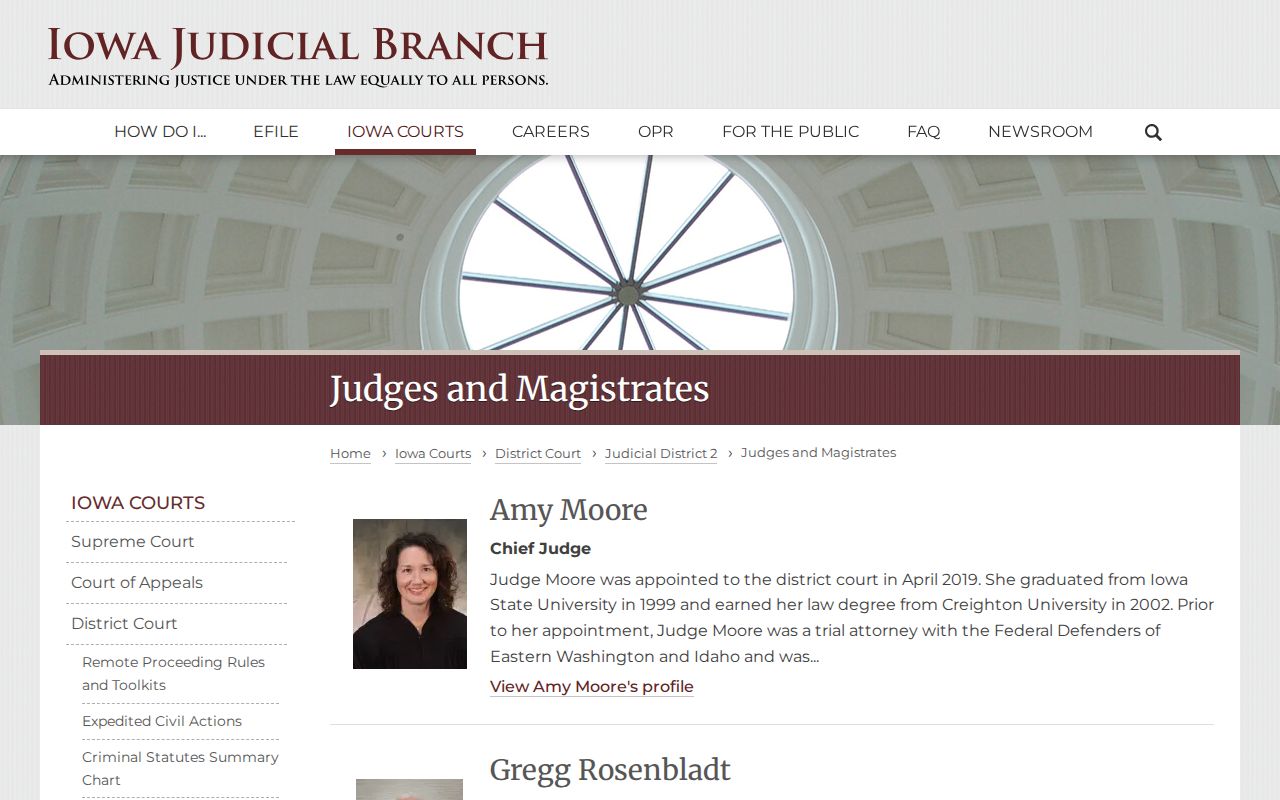
The assigned judicial officer in Marshall County can change, so the current case docket and Clerk of Court remain controlling.
Arrest Warrants: What They Contain
Iowa Code §804.2 governs what goes inside a warrant. Public case information in Marshall County may show the case or warrant number, the subject, the charged offense, the issuing court or judicial officer, and the command to arrest. For a bailable offense, §804.3 calls for an endorsement of the bail amount or other release conditions. Service and return entries appear as the matter progresses. Protected identifiers should be redacted, and probable-cause documents may not be public yet.
| Case or warrant identifier | The official number, shown here only as COURT-ASSIGNED ID; no local format was verified. |
|---|---|
| Named subject | The person identified by the order, with protected identifiers withheld from public display. |
| Charge | The alleged offense, Iowa Code section, and felony or misdemeanor classification. |
| Issuing authority | The Iowa District Court judge, associate judge, or magistrate. |
| Bail or conditions | Case-specific release terms endorsed when the offense is bailable. |
| Service and return | Agency execution, custody, initial appearance, and paperwork returned to court. |
Why Unserved Warrant Material May Be Sealed
Access limit: Iowa Code §804.29 keeps information filed to secure an arrest warrant confidential until arrest and return or initial appearance unless a court orders otherwise.
A public docket can confirm a case exists while withholding the application or affidavit behind a Marshall County warrant. Investigative material still in progress may stay confidential under Iowa Code §22.7, and juvenile records follow separate chapter 232 rules. So a blank document view or a thin search result is not proof that no warrant exists. Public case information is available through Iowa Courts Online and the Marshall County Clerk of Court, while sheriff-held records sit with Sheriff Records. Ask the custodian what is releasable, and give enough detail to locate the record. The Judicial Branch may require a complex request in writing and can charge reasonable retrieval, review, redaction, copying, and postage expenses.
How Warrants Get Served in Marshall County
The Marshall County Sheriff's Office executes arrest warrants, serves legal process, maintains jail custody, and returns process to the court. Marshalltown Police, State Center Police, Iowa State Patrol, or another agency may execute a warrant tied to its own case. Under Iowa Code §805.5, an arrest warrant that follows a willfully missed citation appearance is routed through the clerk back to the agency that issued the citation. Service means law enforcement finds the named person, takes custody under the warrant, and processes the return. Booking, an initial appearance, review of counsel, and a bond or release decision may follow. The sheriff's official pages promise no advance notice, no set place of arrest, and no no-arrest window. An outstanding warrant can be executed during later law-enforcement contact anywhere in Marshall County.
Marshall County Sheriff
2369 Jessup Avenue, Marshalltown, IA 50158
641-754-6380 · Dispatch 641-754-5725
Business hours Monday-Friday, 8:00 a.m.-4:30 p.m.
Marshall County Arrest Warrant Agency Roles
| Agency | Supported role | Contact |
|---|---|---|
| Marshall County Sheriff | Warrant execution, process, custody, records, and court services | 641-754-6380; dispatch 641-754-5725 |
| Marshalltown Police | City arrests and citations; may enforce warrants from city-originating cases | 641-754-5729; dispatch 641-754-5725 |
| State Center Police | City public-safety and issuing-agency channel | 641-754-5725 nonemergency |
| Iowa State Patrol or other agency | May enforce or receive an FTA warrant from its citation | Use the agency identified in the case |
| U.S. Marshals | Federal and cross-jurisdiction fugitive work | Southern Iowa office 515-400-8140 |
The Clerk of Court keeps the docket but does not serve papers. Call the clerk at 641-754-1603 for the judicial record, then the sheriff or originating agency to confirm service. The sheriff's curated Most Wanted page and inmate roster cannot replace that two-part check in Marshall County.
Arrest Warrants, Summonses, and Bench Warrants
These tools demand different responses. An arrest warrant commands custody after probable-cause review. A summons or citation directs a person to appear without immediate custody at issuance. A bench warrant is the plain-language label for judicial arrest authority after a missed hearing or other court violation in Marshall County, though Iowa's specific docket wording controls. A willfully missed citation appearance can create a separate FTA arrest warrant under §805.5.
| Feature | Arrest Warrant | Summons or Citation | Bench Warrant |
|---|---|---|---|
| Direction | Law enforcement takes custody | Person appears as ordered | Custody after missed court duty |
| Basis | Probable cause for an offense | Charge handled without initial arrest | Missed appearance or court violation |
| Issuer | Judicial officer | Officer or court process as authorized | Judge or magistrate |
| Response | Attorney-arranged appearance, surrender, and release process | Appear or respond by the deadline | Confirm required appearance, motion, or bond |
Current Bond Rules Need a 2026 Check
Iowa Code §804.3 requires bail or other release conditions to be endorsed on a warrant for a bailable offense. A 2021 Uniform Bond Schedule offers reference amounts for times when courts are not in session, but it promises nothing about a particular Marshall County case. Iowa Senate File 2399 changed bond provisions effective July 1, 2026. Confirm the current judicial order, charge, circumstances, and release decision before relying on any figure.
Keep the records separate: A court fine or debt, cash or surety bond, personal-recognizance release, and warrant recall are different events. Paying one amount does not prove the warrant was withdrawn.
Marshall County sources publish no local bond-window hours, accepted jail payment methods, surety percentage, refund rules, or bondsman list. Ask the clerk or attorney for the exact condition. Then ask the sheriff where an approved bond is accepted and whether an initial appearance is required. Keep the receipt and confirm the docket and agency return afterward.
Handling an Arrest Warrant in Your Name
Begin with Iowa Courts Online. Then call the Marshall County Clerk at 641-754-1603 to confirm the case, the issuing judicial officer, the warrant entry, and the current bond or release conditions. Sheriff Records, at 641-754-6380, can say whether it holds the warrant for service, as can the enforcing agency named in the record. The sheriff's 24-hour nonemergency line is 641-754-5725. Absence from a Most Wanted page proves nothing.
- Consult an Iowa criminal-defense attorney before appearing or surrendering when arrest is possible.
- Record the exact case number, court, hearing date, warrant entry, and release conditions.
- Ask what the judge requires: appearance, bond, payment, motion to recall or quash, or attorney-arranged surrender.
- Arrange voluntary surrender or appearance only through the court-approved and agency-confirmed route.
- Obtain written payment, appearance, release, or recall documents and confirm that the clerk and agency both processed them.
Important: Marshall County publishes no walk-in surrender schedule or warrant window. Do not arrive unannounced; coordinate with counsel, the court, and the enforcing agency.
Posting bond settles release and a future court date. It does not finish the criminal case itself. A motion merely asks for relief. The warrant stands until the judicial officer grants it. See the Marshall County warrant resolution steps for the full confirmation sequence.