
Marshall County Warrant Searches
Open with the Iowa Courts Online public docket, the route the Iowa Judicial Branch points everyone toward for criminal-case searches. Pick Trial Court and Case Search. Set the county filter to Marshall. A full case or citation number helps when you have one. A matching Marshall County case can show docket activity tied to failure to appear, a hearing, bond, service, return, payment, or an order. Treat the interface honestly, though: it is not a complete active-warrant inventory. Before any follow-up call, gather the full legal name, date of birth, case or citation number, approximate date, county, and issuing agency. Birth dates matter when you speak with an official, even though the public payment search has no such field. A careful Marshall County warrant search leans on both steps.
- Search Iowa Courts Online for the public district-court case.
- Use the payment search for an eligible citation or debt and note any posting delay.
- Call the Clerk of Court at 641-754-1603 to confirm the docket event and issuing authority.
- Call Sheriff Records at 641-754-6380, 24-hour nonemergency dispatch at 641-754-5725, or the issuing police agency for enforcement confirmation.
- Request records from the proper custodian when needed and consult an attorney before arranging surrender or appearance.
Three Online Products, Three Different Answers
| Online source | What it is | Search conclusion |
|---|---|---|
| Iowa Courts Online | Public portion of district-court dockets | Strongest public case source, not a live warrant certificate |
| Most Wanted | Sheriff's curated public-assistance list | An omission does not mean no warrant |
| Inmate roster | Vendor-hosted custody information | Not an active-warrant database |
The Marshall County sheriff's site links all three of these tools, yet each one answers a different question. A person can show up in a public court case and never appear on Most Wanted. The inmate roster only reflects custody information. The IOWA System adds a layer for law enforcement alone, and the Iowa Department of Public Safety offers no public self-service version of it.
What a Warrant Search Asks For
The payment interface gives you two routes. By Name asks for Case Type, County, First Name, and Last Name, and each name field needs at least two characters. A partial citation number works too, using the last four to six digits. By Case or Citation Number demands Marshall County plus the full identifier. Sharper input means fewer false matches. Even so, confirm any apparent match with the clerk. The official field screen lays out these controls on the court's own payment page without exposing a private case.
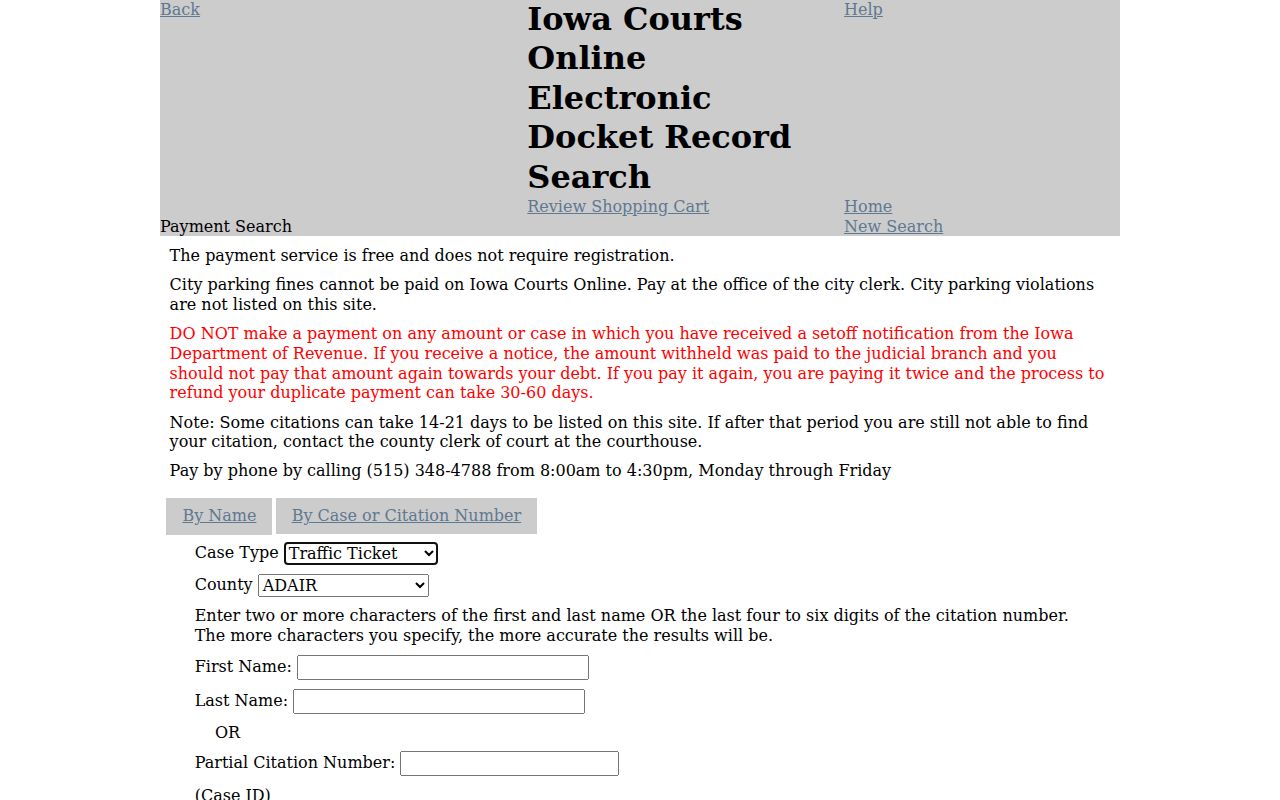
That same screen also marks a boundary. It is a payment and case-identification route, not a substitute for confirming warrant status in Marshall County.
| Field label | Type | Required | Notes |
|---|---|---|---|
| Case Type | Dropdown | Yes in name mode | Choose the relevant court category |
| County | Dropdown | Yes | Select Marshall unless the case arose elsewhere |
| First Name | Text | Yes in name mode | At least two characters |
| Last Name | Text | Yes in name mode | At least two characters |
| Partial Citation | Text | Alternative | Last four to six digits |
| Case ID / Citation | Text | Yes in ID mode | Enter the entire identifier |
Why New Citations Can Be Missing
Timing matters: The Judicial Branch says citations can take 10 to 14 days to appear, while the payment interface warns that some may take 14 to 21 days.
A blank result in that window settles nothing about a court date, a filing, or a failure-to-appear problem. Weekends and holidays can stretch processing. If a deadline is close or already gone, do not sit still just because the search came up empty. Call the Marshall County Clerk of Court with the citation number, date, issuing agency, name, and case type. For an eligible ticket, paying online counts as a guilty plea. A ticket flagged for mandatory appearance belongs in the court's hands instead. When the date was missed or the docket shows FTA, ask whether payment is even accepted, and whether a new appearance, motion, bond, or separate court order is required.
Marshall County Warrant Search Results
A Marshall County warrant search usually returns a public case record, not a tidy "active" or "cleared" flag. Read the docket in order. Find the latest court action. Separate the underlying charge from the warrant event itself. The county publishes no warrant-number format or local status-code glossary, so rely on the exact identifier and wording the clerk gives you.
| Case or citation ID | The record key, represented here only as OFFICIAL DOCKET ID. |
|---|---|
| Charge / offense | Allegation, Iowa Code provision, and classification shown publicly. |
| Issuing court | Iowa District Court judicial officer with jurisdiction over the matter. |
| Warrant reason | Arrest, failure to appear, or other order as the docket describes it. |
| Bond / conditions | Case-specific amount or release conditions, if publicly shown. |
| Service / return | Execution, return, appearance, recall, or later disposition entries. |
What to Ask Marshall County Sheriff Records
When the online docket leaves you guessing, call 641-754-6380 during the sheriff's posted hours, Monday through Friday from 8:00 a.m. to 4:30 p.m. The Most Wanted page also lists 641-754-5725 as a 24-hour nonemergency line. Ask straight questions. Is this a Marshall County warrant? Which court issued it, and which agency holds or serves it? Which official can confirm current bond or surrender instructions? Leave legal advice out of the dispatch call. For a copy of a sheriff-held report, the Records Division wants a written request, a self-addressed stamped envelope, and $5 mailed to ATTN: Records, 2369 Jessup Avenue, Marshalltown, IA 50158. That buys a report copy, not a guaranteed warrant check. Iowa chapter 22 also permits public-record requests by writing, phone, or electronic means, within reasonable expense and confidentiality limits.
Marshall County Warrants: Who Holds What
Two offices answer most warrant questions in Marshall County. The Clerk of Court keeps the official district-court docket, which spans criminal, traffic, scheduled-violation, county and municipal-infraction, and other court matters. The Sheriff's Office handles the law-enforcement side. It serves process, runs dispatch, keeps jail information, and holds its own records. Marshalltown Police and State Center Police also originate or enforce cases inside their city limits. Gilman's official FAQ sends police matters to Marshall County, and a county record documents a Melbourne law-enforcement agreement. Don't look for a separate municipal court or justice-of-the-peace system here. Iowa folded those functions into District Court in 1973. Le Grand adds one wrinkle: the city spills into both Marshall and Tama counties, so check which county name sits on the citation or case before you search. Guess wrong and you get a blank result that means nothing. The state's IOWA System connects more than 450 authorized police, sheriff, state, and federal criminal-justice agencies. The public cannot query it. So a Marshall County warrant check ends where you'd expect: with the clerk and the law-enforcement office handling the matter, not with any statewide consumer portal.
Use Most Wanted Without Overreading It
The sheriff's official Most Wanted page is a narrow tool. It is a curated program that spotlights selected subjects with outstanding warrants and asks the public for tips. There's no name-search form and no stated update schedule. The page never claims to list every active warrant in Marshall County. If your own name, or a relative's, is missing, that proves nothing. Treat an omission as a question, not clearance. The docket, the clerk, and the enforcing agency still give the only case-specific answers. One instruction on the page matters most: call the 24-hour nonemergency line with information. Never try to apprehend anyone yourself.
Which Warrants Stay Restricted
Public access is not the same as full access. Iowa Courts Online shows only the public portion of a court record. The Marshall County clerk or sheriff may withhold or redact material covered by a court order, privacy rules, juvenile law, or an ongoing investigation. So a case can appear on the docket while its supporting affidavit or warrant application stays hidden.
Key rules:
Iowa Code §804.29 makes information filed to secure an arrest warrant confidential until arrest and return or initial appearance unless a court orders otherwise.
Iowa Code §22.7 protects specified confidential records, including some ongoing law-enforcement investigative material.
Iowa Code §232.149 gives juvenile justice records separate public and confidential treatment.
A sealed entry, a missing affidavit, or a juvenile file is not proof that anyone failed to search. Ask the Marshall County clerk's office what can be released. For anything touching you directly, lean on a lawyer's advice.
Confirm the Update After Court Action
Finding the record is only half the job. Payment, appearance, release, bond, a motion, and warrant recall are separate steps. Paying an eligible court debt online does not by itself recall an FTA arrest warrant. Ask the clerk what judicial action is required. Then ask when the official docket will show it.
- Record the exact case or citation number.
- Ask the clerk whether the warrant event remains outstanding and what action the judge requires.
- Follow the approved appearance, payment, motion, or bond instructions, preferably with counsel when arrest is possible.
- Keep the receipt, filing, or court order.
- Recontact both the clerk and enforcing agency to confirm return or recall after processing.
Marshall County publishes no official update timetable, no recall form, no surrender window, and no amnesty program. That silence makes direct follow-up with the clerk essential.